
Why does 240V compliance matter more than the price on a grey import sauna?
Australia runs its homes on 240V at 50Hz. Plenty of saunas sold online are built for a different market: 120V in North America, or a 230V European spec that assumes different wiring rules and plug standards. A heater designed for one supply doesn't simply "work fine" on another because the voltage is close. It draws current differently, its thermal cut-out is calibrated to a different load, and its controller may never have been tested against AS/NZS 60335-2-53, the standard that actually governs sauna heating equipment here.
That's the part the sale price doesn't show you. A grey import can look identical to a compliant unit, right down to the cedar, because the compliance gap sits inside the heater box and the wiring harness, not on the surface. You're not comparing two saunas at different prices. You're comparing a tested appliance to an untested one that happens to look the same.
What exactly counts as a grey import sauna?
A grey import is stock brought into Australia outside the manufacturer's authorised local channel, usually to undercut the price of units that have already gone through local testing and certification. Importing a sauna isn't illegal. The problem is what often doesn't come with it: no compliance plate on the heater, no paperwork showing the controller meets AS/NZS 60335-2-53, and sometimes a plug adapter standing in for a proper Australian-spec connection.
Ask a seller directly where the heater and controller were tested, and ask to see the compliance documentation, not just a brochure photo of a certification logo. If the answer is vague, slow, or redirected to "the manufacturer's website", treat that as the answer. A genuine compliant unit has paperwork ready before you ask, not scrambled together after.
What does AS/NZS compliance actually check?
Two standards do the real work. AS/NZS 60335-2-53 covers the sauna heater and its controller: thermal cut-out behaviour, surface temperatures, and how the unit fails if something goes wrong, because a heater is designed to fail safely, not just to work when everything's normal. AS/NZS 3000 covers the wiring itself: the circuit, the switchboard connection and the isolation needed for a 240V appliance running at sauna temperatures, around 90 degrees C air temperature in most electric cabins.
A compliant installation also comes with a timer and visible signage, which isn't paperwork for its own sake. The timer stops someone leaving a heater running unattended, and the signage tells a guest or tenant what they're stepping into. None of that exists by accident; a compliant build has it fitted before handover, not added later if someone asks.
What can go wrong with a non-compliant heater or controller?
The failure modes aren't dramatic until they are. An uncertified thermal cut-out can let a heater run hotter and longer than it should, because nobody tested where it actually trips. Wiring that doesn't match AS/NZS 3000 can nuisance-trip a safety switch, or worse, fail to trip when it should.
Then there's the paperwork problem, which bites short-stay owners hardest. A council building certifier, your insurer, or an electrician doing a routine check can all ask for compliance evidence on a fixed electrical appliance. No evidence can mean no sign-off, a voided claim after an incident, or a forced removal, after you've already paid for delivery and a base. For a property you rent out to strangers every week, that's not a theoretical risk. It's exactly the kind of gap a tenant's lawyer or an insurer's assessor looks for first.
How do you check compliance before you pay a deposit?
Ask for three things in writing before any money changes hands. First, the compliance standard the heater and controller are certified against, by name, not just "Australian compliant". Second, the heater's rated power draw in kW, so you or your electrician can confirm your circuit and switchboard can carry it; a supplier that won't send this number is hiding the running cost along with the compliance gap. Third, confirmation of who does the electrical connection: an installer's own licensed electrician, or a separate trade you arrange, and whether that's included in the price or quoted after a site check.
If a supplier's price doesn't mention a timer, signage, or who signs off on the wiring, that's the question to ask next, not an oversight to assume away. Ask us for it in writing too; the standard doesn't change because the seller is us.
What does compliance actually cost compared to a grey import?
Here's the maths worth doing before you compare two prices. A grey import that's a few hundred or even a couple of thousand dollars cheaper upfront still needs a licensed electrician to assess it once it's on site, and if the heater or controller can't be certified, you're paying again: either for a compliant heater swap, or for a rewire to bring the circuit up to AS/NZS 3000. Either repair usually costs more than the original discount, and you're paying it after you've already spent on delivery and a base.
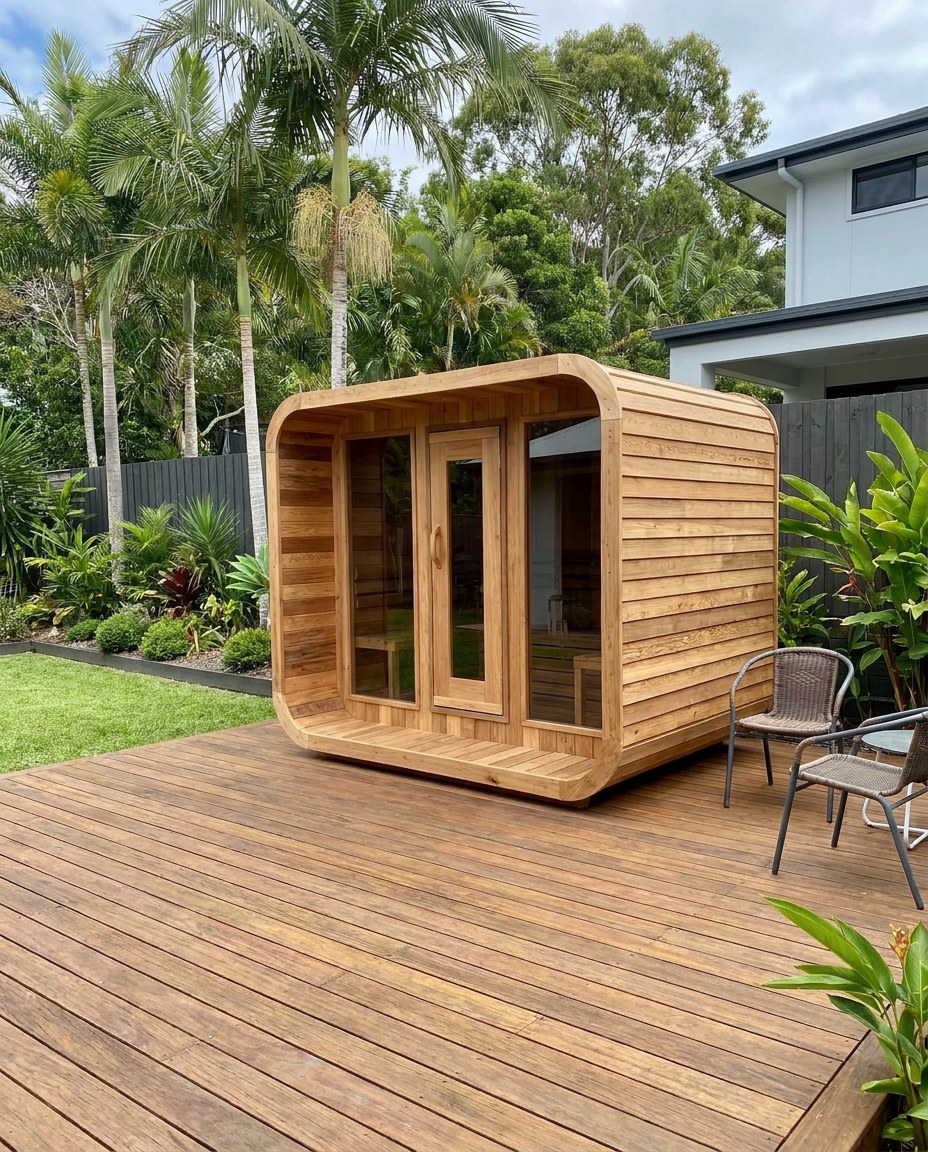
As a reference point, a compliant 4-person cedar sauna installed, heater, controller, timer and signage included, runs at $13,198 for The Cube (4 people), installation included, plus delivery quoted on your address. That figure includes the testing you'd otherwise have to chase separately on a grey import, after the fact, when it's harder and more expensive to fix.
Does the timber matter as much as the electrics?
Less, but it's not nothing. Western red cedar is the standard timber for hot, wet cabins because its natural oils repel moisture and deter insects without any added treatment. A well-built cedar sauna lasts 15 to 25 years, longer with a proper re-oiling cycle every few years, the ongoing cost nobody puts on the brochure but should.
Cedar quality is a timber problem: it affects how the cabin looks and ages, not whether it's safe to plug in. The electrics are a different category entirely, the one where a shortcut doesn't show up until it has to. Judge the timber on grain and finish. Judge the compliance on paperwork, not on how the heater looks through the glass. If you're comparing a 2-person box for a courtyard against something larger, the same rule applies at either size, including on The Cube (2 people): the certification question comes first, the size question second.
Frequently asked questions
Grey import saunas in Australia: why 240V compliance matters more than the price
Because an uncertified heater or wiring can fail unsafely at 240V; compliance testing is what actually makes a sauna safe to install, not the price tag.
What is the difference between a grey import and a compliant sauna?
A compliant sauna's heater, controller and wiring are certified to AS/NZS 60335-2-53 and AS/NZS 3000 for our 240V supply; a grey import usually has no such testing on record.
Can an electrician certify a grey import sauna after it arrives?
Sometimes, but only if the heater itself can be tested and approved; if it can't, you're paying for a replacement heater on top of the original price.
Does home insurance cover damage from a non-compliant sauna?
Often not. Insurers can decline a claim linked to an uncertified fixed electrical appliance, which is exactly the gap a grey import can leave open.
What Australian standard applies to sauna heaters?
AS/NZS 60335-2-53 covers the heater and controller; AS/NZS 3000 covers the wiring and switchboard connection feeding it.
Is a cheaper overseas sauna ever worth the compliance risk?
Rarely. The price gap is usually smaller than the cost of a later rewire, heater swap, or a declined insurance claim.
What should I ask a supplier before paying a deposit?
Ask for the compliance standard by name, the heater's rated power draw in kW, and who holds responsibility for the electrical connection.
General information only. Figures quoted are measured on Gold Coast and South East Queensland short-stay listings and are not a promise of what any one property will earn. Nothing here is tax, insurance or building advice; check with your accountant, your insurer and your local council.