
So, how much does an outdoor sauna actually cost, installed?
Installed cost is the number that matters, not the price on the box. For a modest, accessible Queensland backyard, expect $10,000 to $16,000 for a straightforward prefabricated outdoor sauna. Step up to a better 3 to 6 person unit with a proper slab, a dedicated circuit and normal access, and $16,000 to $25,000 is the realistic band. Premium cabin or barrel builds, tricky electrical trenching or extra landscaping push the total to $25,000 to $40,000-plus.
No government body publishes an official national average for domestic saunas, so those bands are an inference from published supply prices and installer quotes, not a regulated figure. Treat any single number a supplier gives you as a starting point to interrogate, not a verdict.
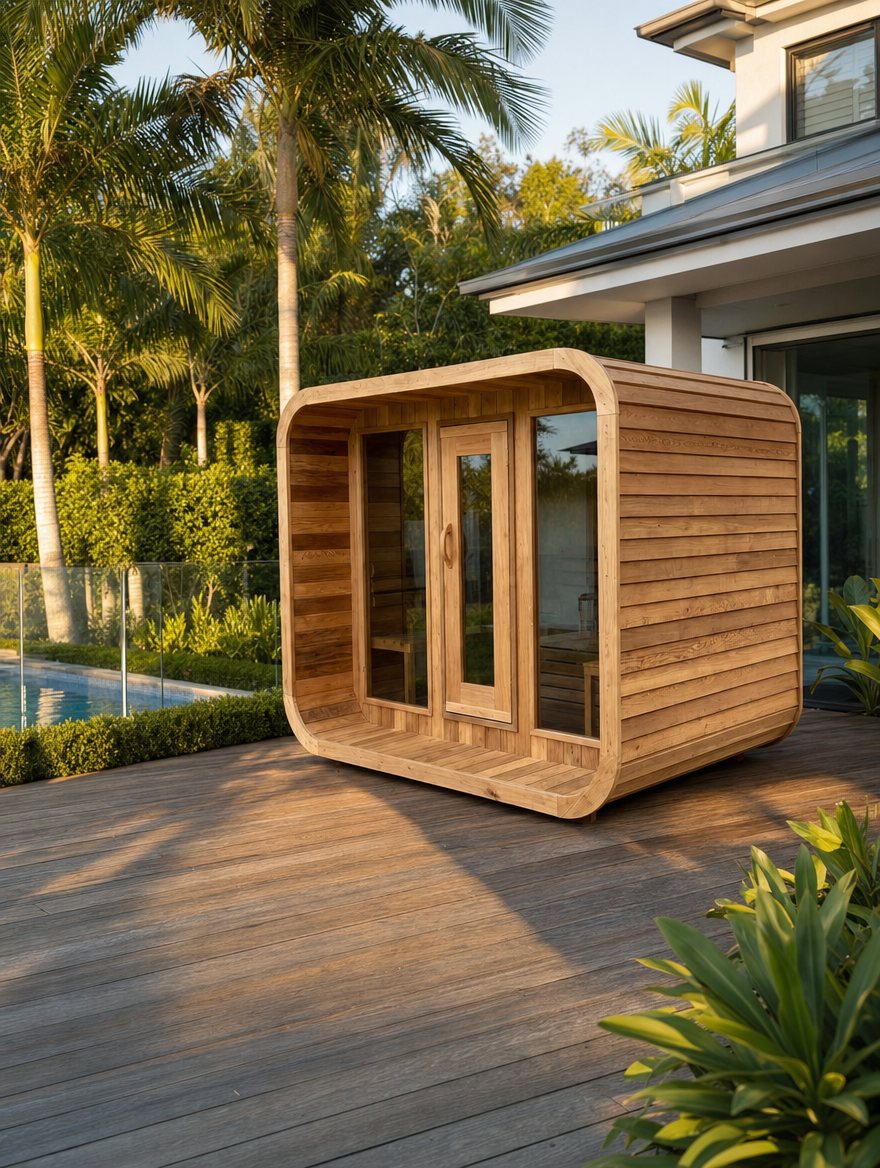
As a factual example of what an installed, compliant price looks like below that range: a two-person cedar sauna installed on the Gold Coast, The Cube (2 people), is $8,498, and the four-person version, The Cube (4 people), is $11,498. Both figures cover the unit, delivery-to-site labour, installation and commissioning, with delivery itself quoted on your address. A cedar cold plunge, Plunge Cedar, installed is $5,000. Buying a sauna and plunge together, The Cube (2 people) + Plunge or The Cube (4 people) + Plunge, comes to $12,499 (a saving of $999 against $13,498 separately) or $14,499. Ask any supplier for the same all-in breakdown before you compare a quote against these.
What's actually included in an installed price, and what gets quoted separately?
This is the part the brochure leaves out. An honest installed quote should separate at least: the unit, heater and controls; delivery to the property itself, not a depot or kerbside drop; assembly and commissioning; a base if the ground needs one; and the electrical run back to the switchboard.
Everything after "the unit" depends on your site. A concrete base is common where the ground isn't flat and firm already, and it is normally arranged through a licensed contractor once someone has actually looked at the spot. The electrical run is priced on distance from the switchboard and whatever the existing board can or can't handle. Access matters too: a build that has to go through a side gate, up steps, or over a fence line costs more labour than one that can be walked straight onto a slab.
None of this is exotic. It's just work that has to happen for the sauna to run legally and safely, and a quote that hides it until after the deposit isn't doing you any favours.
How does a supplied-only sauna price compare to an installed one?
Retail listings for the unit alone sit well below what most people end up paying. Entry-level 4 to 6 person barrel-style outdoor saunas are advertised from around $8,995 to $9,995 for the unit and a 6kW heater, before freight, assembly, base or electrical connection are added, according to an Alpine Spas barrel sauna listing . At the other end, one Australian installer advertises a standard 3 to 4 person outdoor sauna at $24,000 fully installed, and a larger option at $28,000, according to Stillheat . A broader consumer cost guide places installed outdoor saunas anywhere from $4,400 for a basic barrel style up to $31,400 for a custom build, according to Airtasker's sauna installation cost guide . That spread exists because "sauna" covers everything from a flat-packed cabin you assemble yourself to a fully engineered build with a slab, a new circuit and difficult access. The single number that matters for your decision is the installed total, not the unit price quoted in isolation.
How much electricity does an outdoor sauna use, and what does a session cost?
It depends on the heater's rating, the session length and your tariff, and nobody can give you an honest flat number without those three inputs. Most outdoor units in this market run a 6kW heater. Running continuously for one hour, that heater uses 6kWh. On a standard Brisbane retail plan, that hour costs roughly $1.39 to $1.68; on a time-of-use plan it can range from about $0.80 in an off-peak window to $2.09 in a peak window, based on rates listed on the Australian Government's Energy Made Easy plan comparison . That's a heater-on calculation, not a verified session cost: how long it takes to actually reach temperature, and how long you run it after that, depends on insulation, cabin volume, the weather and how often the door opens. Any supplier quoting a flat "cents per session" figure should be able to show you the heater's kW rating, the runtime and the tariff behind it, or the number isn't worth much.
What are the electrical and safety compliance rules for an outdoor sauna in Queensland?
The electrical side of a sauna install is not a DIY job. Wiring has to meet AS/NZS 3000, the wiring rules that set minimum safety requirements for electrical installations, and the sauna and heater themselves have to meet AS/NZS 60335.2.53, the specific appliance standard for sauna heating equipment. In practice that means a dedicated circuit, correct protection devices, and sign-off from a licensed electrician rather than a plug run off an existing power point.
If you're adding a cold plunge as well, there's a separate rule to check: a tub deeper than 300mm can be classed as a regulated pool under Queensland's Building Act, which can trigger a barrier certification requirement. A two-person plunge like Plunge Cedar sits close to that line, so it's worth confirming with your installer before you commit, not after.
What actually pushes an outdoor sauna quote up or down?
Four things move the number more than anything printed on a spec sheet: the base (existing slab or deck versus a new pour), the distance from the switchboard, site access (steps, narrow gates, retaining walls), and the size you choose. As a rule of thumb, a property with 1 to 2 bedrooms is generally well served by a 2-person sauna, while 3 or more bedrooms points toward a 4-person build, which is what most short-stay properties end up choosing; see the short-stay owners page for how owners weigh that decision.
Bundling also changes the maths, and it's worth doing yourself rather than trusting a "bundle discount" line. The Cube (4 people) and Plunge Cedar bought separately would total $16,498. Bought together as a package, that's $14,499, a genuine saving of $1,999. That's a real number you can check against the individual prices on the 4-person sauna and cold plunge pages; not every "package price" in this trade holds up to that test.
The question to ask before you pay a deposit
Ask for the installed total broken into the same line items every time: unit and heater, delivery to your address, base if required, electrical connection, and commissioning. Get it in writing, and hold every supplier, including Dune Living, to that same standard. If a quote can't separate those items, you can't tell whether you're comparing two similar saunas or one honest number against one that's missing half the job.
It's also worth budgeting for what comes after handover. Cedar needs periodic cleaning and re-oiling or staining to stay sealed against weather, similar in spirit to servicing a pool, just less frequent. A price that only ever mentions the day-one cost and calls the timber "maintenance-free" is leaving out a real, ongoing expense.
Frequently asked questions
How much does an outdoor sauna cost in Australia, installed?
Installed outdoor saunas in Australia typically run $9,000 to $25,000 or more, covering the unit, delivery, base and electrical connection; compliant Gold Coast units start at $8,498.
Is the base included in an outdoor sauna price?
Usually not. A concrete or engineered base is normally quoted separately after a site check, because not every backyard needs one and the ones that do vary in cost.
Do I need a licensed electrician for an outdoor sauna?
Yes. The wiring must meet AS/NZS 3000 and the sauna and heater must meet AS/NZS 60335.2.53, so the electrical connection has to be designed and certified by a licensed electrician.
How much does it cost to run an outdoor sauna per session?
It depends on the heater size, session length and your tariff. A 6kW heater running for an hour uses 6kWh, roughly $0.80 to $2.09 depending on the time of day.
Is a cold plunge cheaper to buy than a sauna?
Yes. A cedar cold plunge installed is $5,000, which is cheaper than either sauna size, and buying a sauna and plunge together as a package saves against pricing them separately.
How long does a cedar outdoor sauna last?
A well-built cedar sauna generally lasts 15 to 25 years, longer with consistent re-oiling or staining. Cedar is used because its natural oils resist water and insects.
What size sauna suits a short-stay property?
As a rule of thumb, a 2-person sauna suits 1 to 2 bedroom properties, and a 4-person sauna suits 3 or more bedrooms, which is what most short-stay owners end up choosing.
General information only. Figures quoted are measured on Gold Coast and South East Queensland short-stay listings and are not a promise of what any one property will earn. Nothing here is tax, insurance or building advice; check with your accountant, your insurer and your local council.