
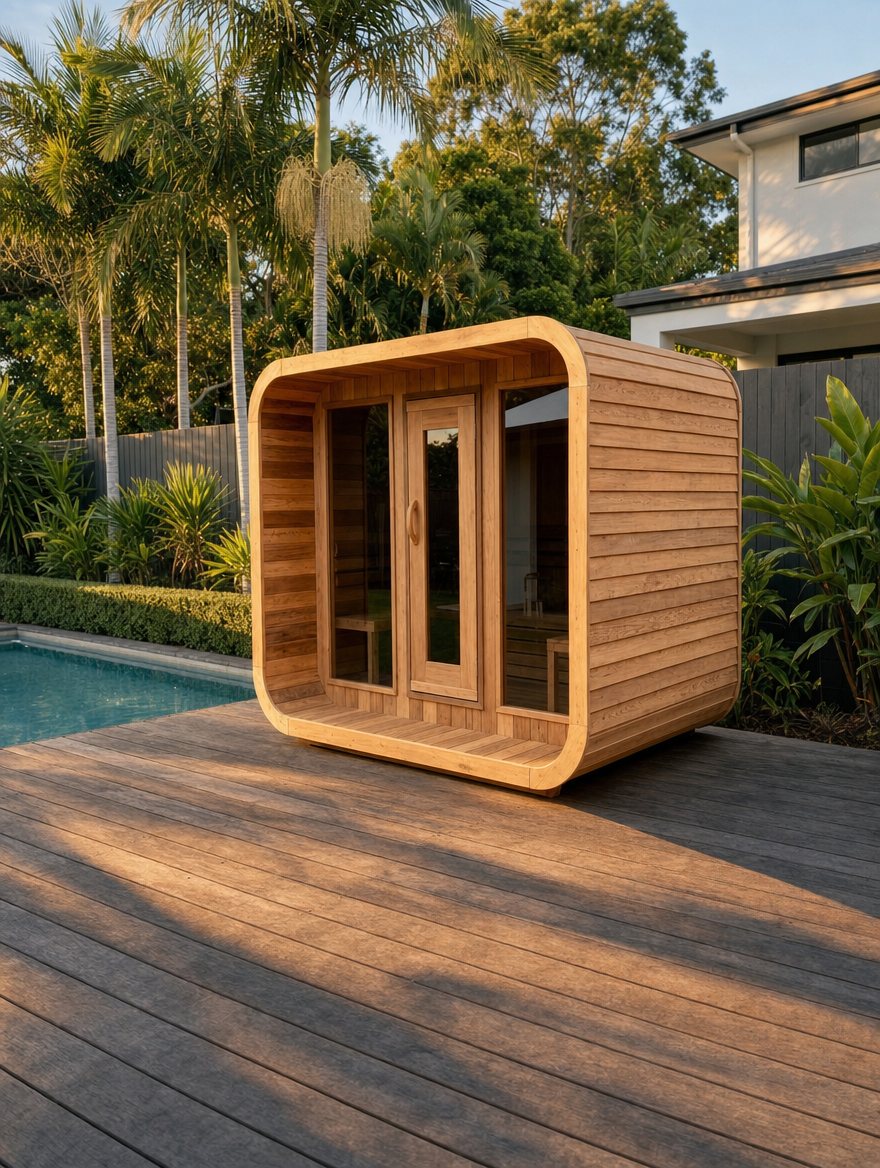
What does an outdoor sauna on the Gold Coast need to survive the climate?
It needs four things working together: a timber that does not rot in humidity, a base that will not shift or pool water, hardware that will not corrode in salt air, and enough ventilation to stop moisture sitting inside the cabin between sessions. Miss one and the others do not compensate for it. A beautiful cedar shell on a soft, undrained patch of lawn will still cup and swell at the door frame within a wet summer.
The Gold Coast sits in a humid subtropical zone: hot, wet summers, mild winters, strong UV year round, and salt-laden air anywhere within a few kilometres of the coast. None of that is exotic for sauna building globally, but it rules out a few shortcuts that work fine in a dry inland climate.
Why timber choice matters more here than inland
Western red cedar is the standard timber for outdoor and hot, wet applications because its natural oils repel water and deter insects without a chemical treatment. That matters more on the coast than it does further inland, where lower humidity gives a lesser timber more of a chance. Cheaper softwoods without those natural oils rely entirely on applied finishes, and a finish only lasts as long as the maintenance cycle behind it.
Solid cedar boards, not veneer over particleboard, are also the difference between a cabin that copes with repeated heat-and-cool cycles and one that delaminates. Guidance aimed at Australian buyers is consistent on this: avoid glued MDF or particleboard in high-heat cabins, and look for 38mm or thicker solid timber walls with low-VOC finishes, as outlined in Best Home Sauna Australia: The Complete Buyer's Guide . A hot, humid sauna is exactly the environment that off-gasses cheap glues fastest.
Humidity, UV and salt air: the three things that break a cheap cabin
Humidity is the constant background threat. A cabin that cannot shed moisture between sessions stays damp at the base and around the door seal, which is where rot and mould start. Cedar's natural decay resistance buys time here that other timbers do not have, which is why it is repeatedly recommended for coastal and humid-climate outdoor builds, as covered in Barrel Sauna Australia: The Complete Buyer's Guide .
UV is the slow one. Unprotected or poorly finished cedar greys and dries out under constant Queensland sun, which can lead to surface checking (fine cracking) over a few summers. A quality oil or stain finish, reapplied on a cycle, is what stops that, not a one-off factory coat.
Salt air is the one people underestimate. Within a few kilometres of the beach, salt accelerates corrosion on anything that is not stainless steel or a marine-grade fitting, hinges, bands, screws, the lot. It is a reasonable question to ask any supplier before you pay a deposit: what grade is the hardware, and is it in writing?
Heater sizing and ventilation for a Queensland build
Heater sizing is usually judged on cabin volume, not just floor area, with undersizing flagged as the most common mistake, as noted in Outdoor Sauna Australia: The Complete 2026 Guide . Dune Living provides the heater's rated draw for each build on request rather than publishing a generic guide figure. A bigger heater is not automatically better: an oversized unit in a small cabin heats unevenly and wastes power, while an undersized one struggles to hold 90 degrees C on a humid, breezy evening.
Ventilation is not optional in a humid coastal build. Vents let the cabin dry out between sessions and stop condensation sitting in the timber joints, which over a wet Gold Coast summer is the difference between a cabin that lasts and one that starts smelling musty by year two.
Foundation, siting and drainage on the coast
A solid, level foundation carries the weight of the cabin and stops it shifting on soft or sandy Gold Coast soils, which is a common site condition close to the beach. Drainage matters just as much: water pooling under or against the cabin base is a slower, quieter way to rot a sauna than any storm.
A reasonably flat, firm base and clear access wide enough to get the build through are the two things worth checking before you commit. If the ground needs a concrete pad, that is arranged through a licensed contractor and quoted on the address, separate to the unit price. Wind exposure is worth thinking about too: an unshielded, elevated deck copes with more weather load than a sheltered courtyard.
Building approval: what Gold Coast councils actually require
A pre-built outdoor sauna cabin is commonly treated as a Class 10a structure (a non-habitable outbuilding), and many councils exempt structures under 10 square metres from formal building approval. That threshold catches most single-family sauna cabins, including a 4-person build at roughly 3.2 square metres of footprint. But exemptions are set locally, not nationally, so this is genuinely a "check before you commit" item, not an assumption.
The question to ask before paying a deposit is simple: has this been checked against my specific council's rules, not a generic national guideline? A supplier who cannot answer that clearly is not one to trust with the electrical run either.
What outdoor rated actually means and what upkeep looks like
There is no single, universal certification that makes a sauna "outdoor rated." It is a marketing phrase, not a standard. What actually determines whether a cabin survives outdoors is the combination already covered here: solid timber species, joint quality, finish, hardware grade and site drainage, not a sticker on the box.
Maintenance is real and ongoing, not a one-off. Cedar needs periodic cleaning and re-oiling or staining on a cycle to stay sealed against humidity and UV, budgeted like pool servicing at a lower frequency. Skipping that cycle is the single most common reason a coastal cabin looks tired well before the timber itself has failed.
What an installed cedar sauna costs on the Gold Coast
Australian outdoor sauna projects commonly range from a few thousand dollars for a basic kit to well over $20,000 for a larger, fully fitted cabin, according to Outdoor Sauna Australia: The Complete 2026 Guide . As one factual reference point at the installed end of that range: a 2-person cedar cabin, delivered and commissioned, runs from $8,498, and a 4-person cabin from $11,498, both with installation included and delivery quoted on the address. Ask any supplier for their installed total in writing, not a "from" price that assumes you do the base and wiring yourself.
Sizing is usually simple: a 1 to 2 bedroom property suits a 2-person cabin like The Cube (2 people), while a 3 or more bedroom property, or a short-stay listing, more often suits a The Cube (4 people). Owners pairing a sauna with a cedar cold plunge for contrast therapy typically look at a bundled install, such as The Cube (4 people) + Plunge, to get both units commissioned in one visit.
Frequently asked questions
Does a cedar sauna need a concrete base on the Gold Coast?
Most builds need a firm, level base. On sandy or sloped Gold Coast blocks that usually means a concrete pad poured first, arranged through a licensed contractor and quoted separately after a site check.
Do I need council approval for an outdoor sauna in Queensland?
Often not, if the cabin is under 10 square metres, since it is typically treated as an exempt Class 10a structure. Rules are set locally, so confirm with your specific council before committing.
How much maintenance does a cedar sauna need in a coastal climate?
Ongoing, not zero. Expect periodic cleaning and re-oiling or staining on a cycle, roughly comparable in frequency to servicing a pool, to keep the timber sealed against humidity and UV.
Can salt air near the coast damage a cedar sauna?
Yes. Salt accelerates corrosion on hinges, bands and screws that are not stainless steel or marine-grade, faster than an equivalent inland site.
How long does a western red cedar sauna last outdoors?
Around 15 to 25 years with consistent maintenance. Skipping re-oiling or poor drainage at the base shortens that significantly in a humid climate.
What type of heater does an outdoor sauna on the Gold Coast use?
Dune Living saunas are electric only, on a compliant 240V circuit. Electric heaters are the simpler, more common choice for suburban sites.
What is the difference between a good and a cheap cedar cabin?
Solid timber over glued particleboard, 38mm or thicker walls, stainless hardware, real ventilation and a properly sited base. Any of those missing shortens the cabin's life on the coast.
The short version
An outdoor sauna survives a Gold Coast summer on the strength of decisions made before the first session: solid western red cedar over a glued panel, stainless hardware over standard steel, a drained and level base over a flat patch of lawn, and a maintenance cycle that actually gets followed. None of that is exotic. It is just the difference between a cabin that looks the same in year five and one that does not make it there.
For sizing and installed pricing by property type, see the short-stay owners guide, or compare listing data at market data.
General information only. Figures quoted are measured on Gold Coast and South East Queensland short-stay listings and are not a promise of what any one property will earn. Nothing here is tax, insurance or building advice; check with your accountant, your insurer and your local council.