
How do you size a sauna and cold plunge for a short-stay property by bedroom count?
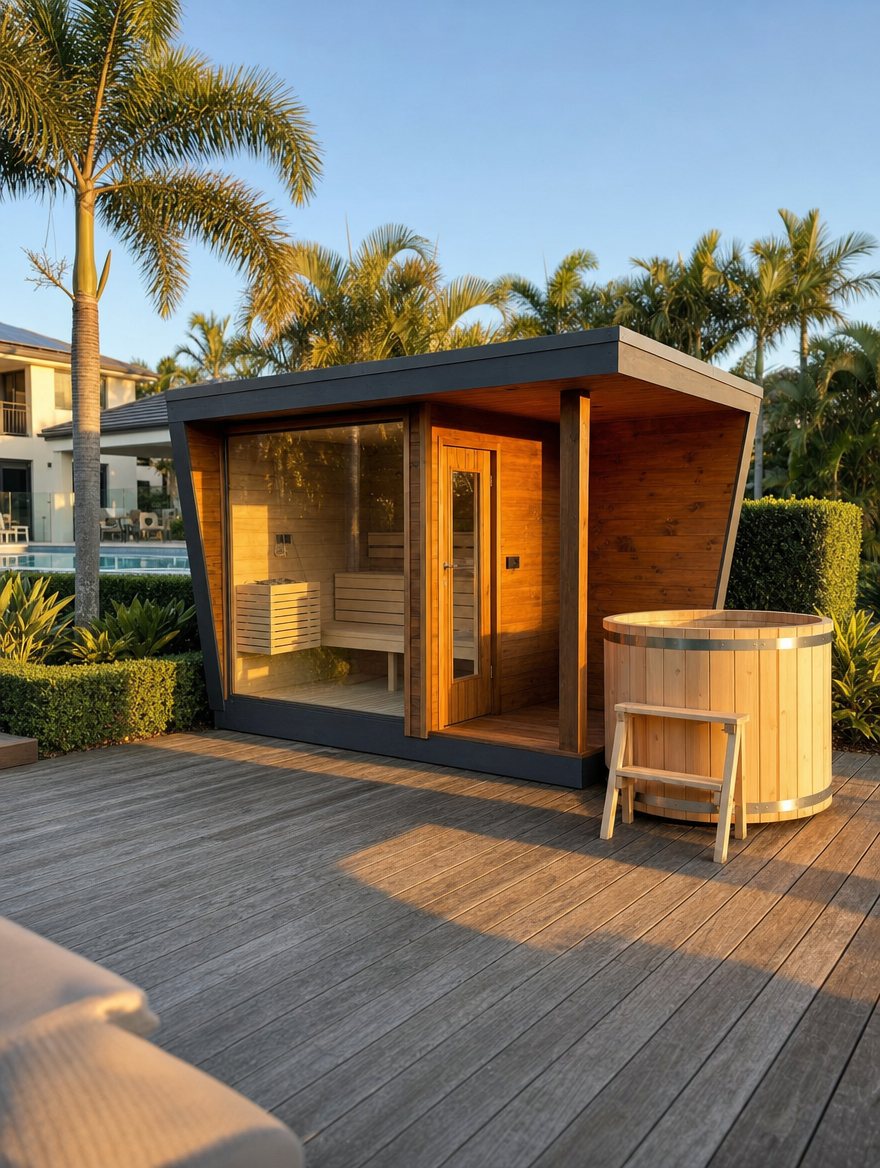
For a short-stay property, sauna capacity should roughly track bedroom count. A 1 to 2 bedroom property, the kind that sleeps two to four guests, suits The Cube (2 people) at 1200 x 1500 x 2000mm. A property with 3 or more bedrooms, sleeping six or more, suits The Cube (4 people) at 1800 x 1800 x 2100mm. The cold plunge does not follow the same scale: Plunge Cedar is a 2-person tub either way, because a plunge is a short, alternating turn, not a group sit-down.
Sizing guides written for hospitality settings make the same point: match capacity to how many people will actually be in the room together at once, not total headcount on site, because a session-based amenity like a sauna loses its appeal fast once it feels crowded. That is why bedroom count is a useful proxy for expected group size rather than a strict formula.
Why bedroom count works as a proxy, and where it breaks
Bedroom count correlates with how many guests are usually on site together, which is the number that actually matters for a session-based amenity. It is not a perfect match. A 2-bedroom property that regularly hosts extended family for a weekend will push past a 2-person sauna fast, while a 4-bedroom share-style listing booked by solo travellers off-peak may rarely fill a 4-person cabin. Treat the bedroom rule as the default, then adjust for how the property is actually booked.
For properties larger than four bedrooms, sizing beyond The Cube (4 people) exists on request but sits outside the standard range and needs a site conversation rather than an off-the-shelf answer.
The Cube (2 people) vs The Cube (4 people): what the extra footprint buys
The 2-person build is a barrel-form cabin with a full glass front, sized at 1200 x 1500 x 2000mm, which suits a courtyard or narrow deck where a larger square footprint will not fit. The 4-person build is a square cabin with glass either side of the door, sized at 1800 x 1800 x 2100mm, and covers most homes and nearly every short-stay property. The price difference is $4,200 installed ($13,198 versus $8,998, both plus delivery), which roughly buys double the seated capacity and a wider stance on the deck.
Space planning guides for outdoor saunas in Australia generally recommend confirming clearance around the cabin for door swing, ventilation and maintenance access before settling on a footprint. A narrow terrace unit is often the deciding factor over bedroom count alone: a 3-bedroom property with a tight courtyard may still land on the 2-person build simply because the 4-person footprint will not clear the gate.
Does the cold plunge need to match the sauna?
No. Plunge Cedar is a fixed 2-person tub at 1570 x 1070 x 710mm regardless of which sauna it pairs with, because guests plunge briefly and in turns rather than as a group activity the way a sauna session runs. The tub holds itself at about 4°C with a built-in chiller, so there is no ice run to manage between guest changeovers.
What does change with property size is the space between the two units. Guides on combining a sauna and cold plunge on one site generally recommend a clear, non-slip path between the hot and cold zones so the hot-to-cold transition is safe rather than a trip hazard. A larger property with more deck room can plan that clearance properly; a tight courtyard install needs it checked before the deposit stage, not after.
Base, power and the Queensland compliance rule that catches people out
Regardless of which size you land on, the site needs three things: a reasonably flat, firm base, a path wide enough to get the build through, and a dedicated electrical circuit run back to the switchboard. All of this is checked before an owner commits, and the base and electrical run are quoted separately once the site is seen, because ground condition and cable distance vary property to property.
Electrical compliance matters more than most brochures let on. A sauna heater and controller should be specified against AS/NZS standards, with a compliant timer and signage, not just wired in with a household plug. General buyer guides on home saunas in Australia point to the same standard as the baseline to check before signing off on any install, regardless of supplier.
Council approval is the other variable, and it is genuinely council-specific rather than a single national rule. Some councils treat small pre-built outdoor structures as exempt, others require an approval step, and the answer changes by local government area. Check with your own council before you assume either way.
The cold plunge carries its own Queensland-specific catch. A tub deeper than 300mm can be treated as a regulated pool under the Building Act, which may trigger barrier certification requirements. Plunge Cedar at 710mm deep is more than double that threshold, so barrier certification requirements very likely apply, and this is worth confirming with your council or building certifier before you build a fence plan around it, not after.
Does bedroom-driven sizing change what guests pay?
Here is where it is worth being precise about what the data actually shows. A review of 484 live Gold Coast and South East Queensland listings in August 2026 found that listings with a spa carry a median nightly rate premium over listings without one, controlled for bedroom count: roughly +12% for 2-bedroom listings, +23% for 3-bedroom, and +9% for 4-bedroom, a band of about +9% to 23% overall (Dune Living market data). That premium is measured on spas, the wet amenity the dataset can see across a large sample, not on saunas or cold plunges specifically.
So treat it as context for how guests value a wet amenity generally, not a promise about what a particular sauna size will do to your rate. About 55% of competing listings in that dataset already have a spa, which is a useful benchmark for how common the amenity category has become, whatever wet amenity you choose to add. Owners sizing a listing can run their own numbers on the short-stay owners page, which draws on the same dataset.
Frequently asked questions
Sauna and cold plunge for a short-stay property: sizing by bedroom count
A 1 to 2 bedroom property suits a 2-person sauna; 3 or more bedrooms suits a 4-person sauna. The cold plunge stays a 2-person tub either way.
Can two guests use a 4-person sauna comfortably?
Yes. The larger cabin gives two guests more bench room and a cooler run near the door, which suits couples who still want the bigger footprint for occasional larger bookings.
Do I need council approval for an outdoor sauna in Queensland?
It depends on the council and the structure size. Some small outdoor builds are exempt from approval, others are not, so check with your local council before you commit to a size or a base.
How much power does a short-stay sauna need?
Enough for a dedicated circuit sized to the heater's rated draw. Larger cabins draw more power, so confirm the exact figure with your electrician before install day rather than relying on a generic average.
Is a cold plunge always a two-person tub?
In the Dune Living range, yes. Plunge Cedar is a fixed 2-person tub at 1570 x 1070 x 710mm, regardless of which sauna size it pairs with.
Does a bigger sauna mean a bigger nightly rate?
It is not proven either way. Measured rate premium data covers spas, not saunas specifically, so treat any sauna-specific rate claim with caution until better data exists.
How long does a cedar sauna last with regular short-stay use?
Typically 15 to 25 years, longer with consistent maintenance such as periodic cleaning and re-oiling on a set cycle, similar to budgeting for pool servicing at a lower frequency.
General information only. Figures quoted are measured on Gold Coast and South East Queensland short-stay listings and are not a promise of what any one property will earn. Nothing here is tax, insurance or building advice; check with your accountant, your insurer and your local council.