
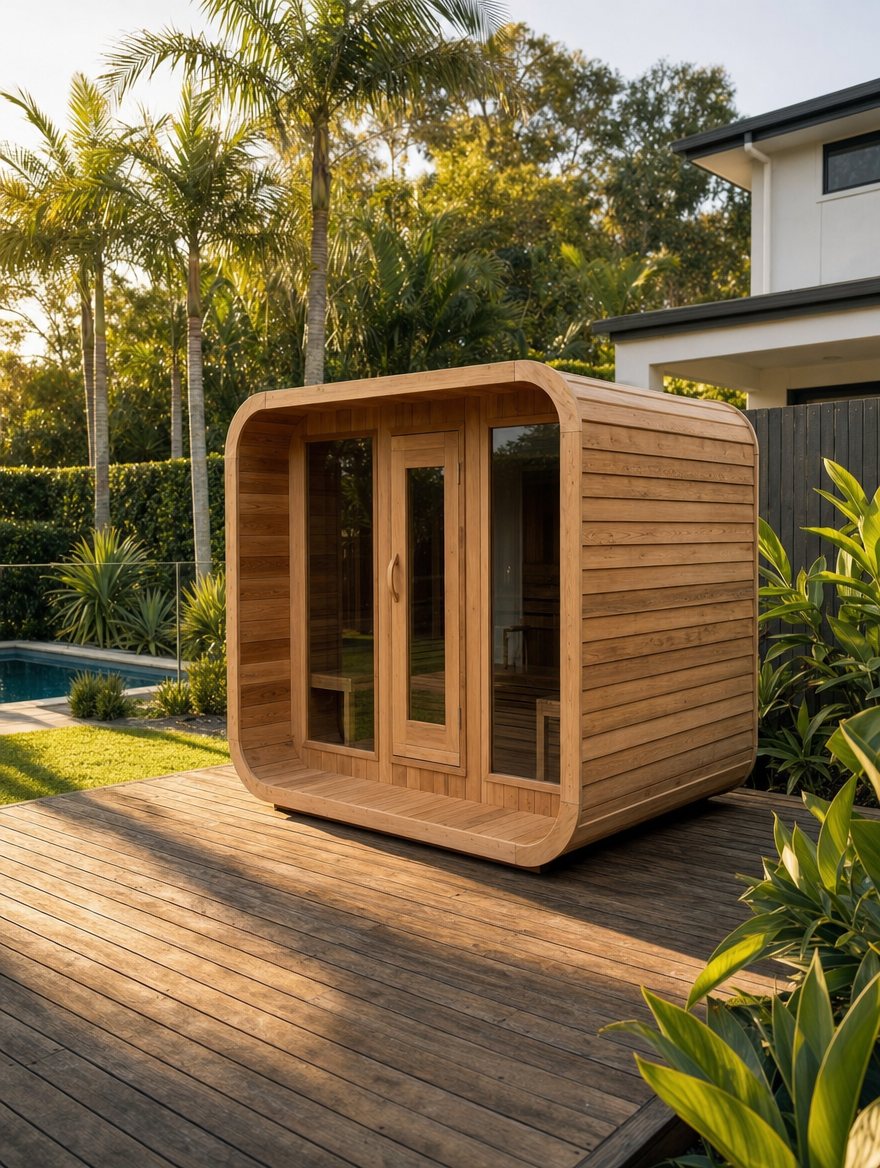
What does it cost to run an electric sauna in Australia?
Short answer: most households spend somewhere between $1 and $4 per session, and a family using a sauna four times a week lands closer to $16 to $64 a month. Three numbers decide where you sit on that range: how many kilowatts the heater is rated at, how long you run it for, and what you pay per kilowatt hour on your electricity plan.
None of that is secret, and none of it should be guessed. A two-person cabin heats a smaller volume than a four-person cabin, so it typically draws less; see the specifications for The Cube (2 people) and The Cube (4 people) for the exact dimensions each heater has to work with. Beyond size, insulation, outdoor temperature and how long you preheat all move the number up or down. The only figure worth trusting is the one you calculate yourself from your own heater's data plate and your own electricity bill, not a flattering average handed to you by whoever is selling the sauna.
Do the maths yourself: the formula sauna sellers skip
The formula is simple enough to do on your phone: heater's kW rating x hours run x (cents per kWh ÷ 100) equals cost per session.
Say a heater is rated at 4.5kW, you run it for one hour, and your tariff is 30 cents per kWh. That is 4.5 x 1 x 0.30, which comes to $1.35. Run it for two hours and it is $2.70. A larger cabin with a heater rated closer to 6kW, over the same hour on the same tariff, comes to $1.80.
Those figures are illustrative, not a quote for any specific build, because the actual draw depends on the heater fitted and the cabin it is heating. What matters is the method: find the kW on the heater's data plate, which every compliant heater sold in Australia has, multiply by how long you actually run it, multiply by your tariff, divide by 100. That is the whole trick. Anyone quoting you a flat "a few dollars a session" without showing that working is rounding in their own favour, not yours.
How your electricity tariff changes the number
The same heater costs different amounts to run depending purely on when you switch it on. Flat-rate residential tariffs across Australia generally sit somewhere in the 25 to 40 cents per kWh range, so use the rate on your own bill rather than a number from this page. If you are on a time-of-use plan, running a sauna during an evening peak window can cost noticeably more than running the identical session in the middle of the day.
Households with solar and a feed-in tariff not worth chasing often find a daytime session costs close to nothing, because the power is already being generated and would otherwise be exported for a few cents. If you are deciding when to switch a sauna on, check your tariff structure before you check the weather.
What else changes the running cost
Heater size is the biggest lever, but not the only one. A well-built cabin holds heat; a draughty one leaks it straight back out, which means the heater cycles on more often to hold around 90 degrees Celsius. Outdoor temperature matters too: a sauna preheating on a cold winter night in the hinterland works harder than the same cabin on a mild Gold Coast evening.
Session length and preheat time add up in a way most people do not track: a cabin left preheating for 40 minutes before anyone gets in costs more than one timed to finish just as the first person arrives. The Cube (2 people) suits a smaller footprint and a smaller heater load, while The Cube (4 people) covers more people at once but draws more to heat the larger volume. Matching cabin size to how many people actually use it most sessions is the simplest running-cost decision most buyers skip.
What a cold plunge adds to the power bill
A cold plunge with a built-in chiller is a different kind of running cost to a sauna heater. Instead of one burst of heat followed by thermostat cycling, a chiller works continuously, in smaller amounts, to hold the water at a steady temperature, around 4 degrees Celsius for a cedar plunge like Plunge Cedar.
That continuous, low-level draw is why a chiller's running cost should be compared over a week or a month rather than per session; a single soak is not really the unit that matters. Ask for the chiller's rated draw the same way you would ask for the sauna heater's, and add the two together if you are costing out a combined setup rather than assuming the sauna number covers both.
The question to ask before you pay a deposit
Ask for the heater's rated draw in kilowatts, in writing, before you sign anything. Not a line like "it's very efficient" or "it costs a few dollars a session", the actual number off the data plate. Do the maths from the section above with that number, your realistic session length and your own tariff, and you will have a running cost nobody can talk you out of later.
Ask the same question about any cold plunge chiller. A seller who will not put the kW in writing is asking you to trust a feeling instead of a fact, which is exactly the gap this guide exists to close. We send the heater's rated draw for our own range on request rather than quoting a flattering average, and any seller should be willing to do the same.
Electricity isn't the only running cost
Power is the smallest recurring cost of owning a sauna, and it is the one sellers are happiest to talk about, because it sounds cheap next to the purchase price. Cedar is not maintenance-free. It needs periodic cleaning and re-oiling or staining on a cycle to stay sealed against moisture, budgeted more like occasional pool servicing than a one-off job.
Skip that cycle and the timber weathers faster; keep to it and a well-built cedar sauna can last 15 to 25 years. If you are adding up the true cost of running a sauna, put maintenance in the same column as electricity, not in a separate box marked "later".
Frequently asked questions
What does it cost to run an electric sauna in Australia?
Most sessions cost $1 to $4, depending on heater size, run time and tariff; multiply kW by hours by cents per kWh, then divide by 100.
How many kilowatts does a home sauna heater use?
Heater size varies by cabin volume; ask for the exact rated draw in kilowatts off the data plate rather than relying on a general estimate.
Does running a sauna at night cost more than during the day?
It can. Time-of-use tariffs often charge more in the evening peak, while solar households may run a daytime session for close to nothing.
How much does a cold plunge chiller cost to run?
A chiller draws continuously at a lower rate to hold the water cold, so compare its cost weekly rather than per session; ask for its rated draw.
Is an electric sauna's running cost easy to predict?
Yes. Unlike a flat seller estimate, electric running cost is transparent and calculable directly from heater kW, run time and tariff.
Do I need a special electrical circuit for a home sauna?
Compliant heaters are specified against AS/NZS standards and supplied on 240V, 50Hz; check the specific circuit requirement with a licensed electrician before installing.
How often do I need to budget for sauna maintenance besides electricity?
Cedar needs periodic cleaning and re-oiling or staining on a cycle to stay sealed, more like occasional pool servicing than a one-off cost.
General information only. Figures quoted are measured on Gold Coast and South East Queensland short-stay listings and are not a promise of what any one property will earn. Nothing here is tax, insurance or building advice; check with your accountant, your insurer and your local council.